
Blog post 100!

Today's post is the 100th of the Pacific History Guide blog, and to mark the occassion we're revealing new location pages! One of my stated goals for 2026 was establishing two new locations, but after a long hospital stay (I'm fine) and the wealth of free time that provided (I'm fine, really), we're doubling the quota and announcing FOUR new pages, enjoy!

I'm super excited to add Malaysia to PHG. I first visited this country during its 50th Hari Merdeka, or Independence Day in 2007 (the actual day is 31 August, just a couple of days from now as of this writing). I went back in 2012, but haven't had the opportunity to visit since. I'm fascinated by Malaysia's history; the people there have a fierce pride in the freedom that they've fought tooth and nail to win and defend.
The next time I visit, I'm going to check out some of the battle sites of the Second World War, such as Kota Bharu, and the memorial for the HMS Repulse and HMS Prince of Wales in Kuantan. I also want to visit the war museum in Kelentan. The Malayan Emergency, in which the British and Malay fought a communist insurgency, has various memorials around the country. I've been itching to visit Penang, where the Japanese surrendered to the British in 1945. Across the South China Sea is Eastern Malaysia, which shares a land border with Indonesia and Brunei. Labuan is the place I most want to visit here; the peace park looks beautiful.

Adding a San Diego page to PHG was a no-brainer, as I was living there at the time. But I struggled with finding a new (mainland) American location; I finally landed on San Francisco. I've always wanted to visit this city, and for some reason I've never made it. I picked San Francisco because it's home to many important historical sites. The U.S. Navy has a strong history in San Francisco; the former Naval Air Station Alameda across the bay played a large part in the Second World War. USS Hornet (CV-8), now a museum ship, keeps that history alive. Yerba Bueno, a nearby island part of San Francisco proper, served as home to technical schools.
San Francisco's proud maritime tradition is on display in North Beach; along with most of the city this area was devastated in the 1906 earthquake. A personal hero of mine, A.P. Giannini, founder of the local Bank of Italy, went down to the ruined docks days after the earthquake and fire to issue loans and extend credit to the local fishermen and market owners, much of it on a handshake basis, in order to rebuild San Francisco.
Elsewhere, San Francisco's Chinatown, Presidio, and Lincoln Park are must-visits, and at the top of my list. Angel Island, where some 500,000 immigrants to the United States were processed, is part of this city. The island was also used for Japanese Internment from 1942-1944. I also discovered that Sharp Park, an area in the south of the city, was home to a detention center during this period; there is no memorial or marker here, however. The Densho Project helps keep the history of Japanese exclusion and internment alive. Of the various shameful episodes in American History, this is probably the one that's most at risk of being forgotten. You can visit the Densho Encyclopedia here.

I've been meaning to visit the Marshall Islands for years. There are several memorials and monuments on Kwajalein and Majuro Atolls, most of them dedicated to battles that took place while the islands were violently changing hands between the Americans and Japanese. A monument that I discovered while searching Majuro was dedicated by the Emperor of Japan (Taisho) in 1918, to honor the victims of a particularly bad typhoon that hit the island, killing 200 people. This is called the 'Holy En' monument.
The marker says:
"On November 8, 1918, a typhoon hit the Marshall Islands, and the large waves washed away private houses in Majuro, causing more than 200 casualties. His Majesty, who received the report of this typhoon damage, on January 14, 1919, he gave money from his private funds. It was to be given a private sympathy money from the emperor. All the victims were deeply moved by His Majesty's heart of one-mindedness to the islanders far away in the South. Therefore, in order to teach the islanders the spirit of loyalty and filial piety, and to keep a record of gratitude to His Majesty for many years to come, he decided to provide with respect and pass it on to future generations.
November 14, Taisho 8, Commander of the Provisional Southern Islands Defense Force, Rear Admiral, Fifth Rank, Second Class, Third Class, Taijiro Nagata"
The United States used the Marshall Islands as a nuclear 'proving ground', performing 67 nuclear blast tests throughout the atolls, including on Bikini, where the local residents were forcibly relocated. Many people remain in exile, and the compensation money ($2bn promised) has since run out. The Bikini Atoll nuclear blast sites are listed as a UNESCO World Heritage Site, the only one in RMI. The RMI has a diaspora throughout Micronesia and in the United States.
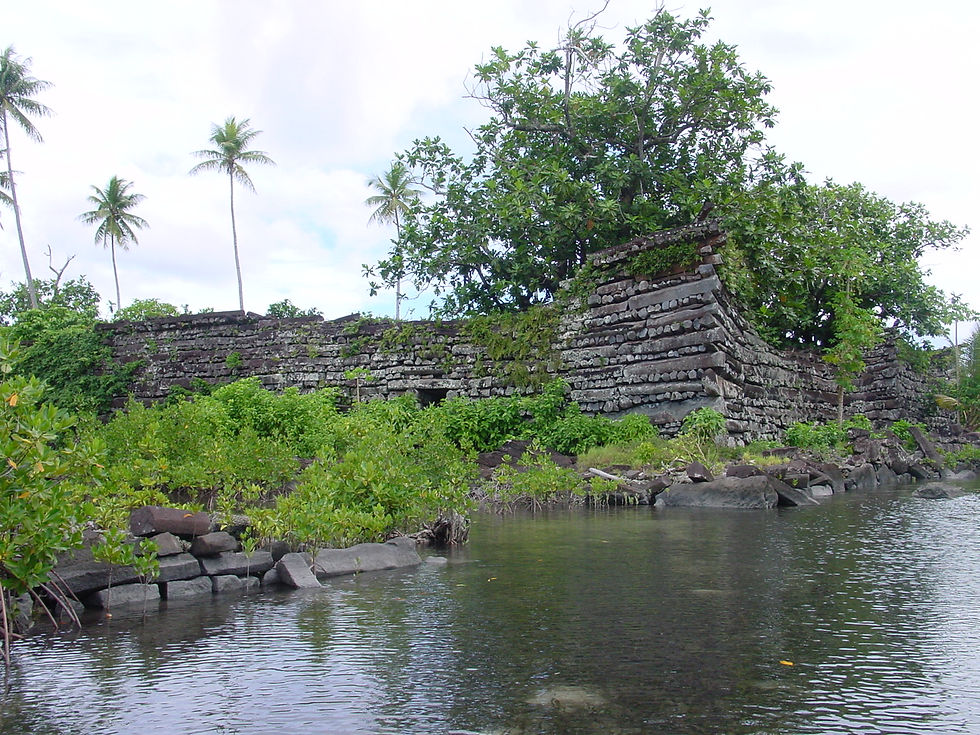
Last but certainly not least: The Federated States of Micronesia! Here, you can find several impressive cultural and historical landmarks; perhaps the most impressive being Nan Madol on Pohnpei. Serving as the capital of Temwen Island and constructed between 1200 and 1500 CE, this complex network of canals and islets was built using stones weighing up to 90 tons. Locals on Pohnpei give tours of the existing complex; although much of it has been reclaimed by the sea and dense mangrove growth, you can get a good view of Nan Dauwas, the "Mouth of the High Chief". Nan Madol is the only UNESCO World Heritage site in the FSM; there are only three such sites across all of Micronesia.
I am beyond excited to launch these four new pages, and I hope you all feel the same way. If you've been to any of these locations and want to help add context, fix a mistake, or just tell me what you think in general, please do! Pacific History Guide is here to connect you with local and regional history, where you are. Here's to another 100 blog posts!
Happy exploring,
Tony


Comments