
Kanrin Maru Memorial - San Francisco

San Francisco's Lincoln Park, situated in the northwest of the peninsula, is home to several monuments. Among these are military fortifications, a Holocaust Memorial, and a marker for the end of the Lincoln Highway. Situated among these landmarks, not far fron a statue of El Cid, is the Kanrin Maru Memorial. This place marks a seminal event in pacific history; the first time a Japanese ship made landfall in the United States, in 1860.
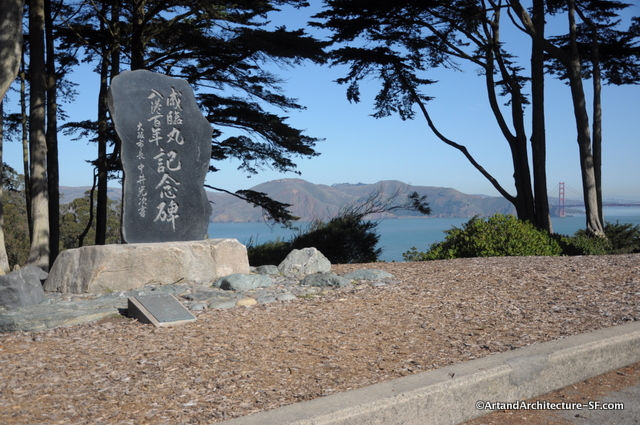
The Kanrin Maru 咸臨丸 was a Bali-class sloop, built by L. Smit en Zoon in the Netherlands. Second of the class of five, Kanrin Maru was ordered in 1854 along with two others to fill out the Shogunate Navy, as a direct response to Commodore Matthew Perry's forced opening of Japan in 1853. She was delivered to Nagasaki in 1857, where her name was changed from Japan to Kanrin Maru. The other two ships, Choyo Maru and Denryu Maru, were delivered shortly after.

Kanrin Maru's first mission was to serve as a training ship at the newly established Naval School in Nagasaki, where she joined Kanko Maru, the first ship built in the Netherlands to be presented to the Shogun. The Dutch, who had been the only people allowed to do business in Japan during the Sengoku Era and maintained their favored status following the opening of the country, trained Japanese crews on the emerging technology of steam-driven power in the Shogun's fledgling navy. In 1856, the Dutch succeeded in concluding a formal treaty with the Japanese, the "Dutch-Japan Treaty of Peace and Amity" which affirmed rights for traders to move on and off Dejima Island (where they had been segregated throughout the Sakoku Period). Additional treaties regarding overseas trade were signed in 1857 and 1858.
Studying the events of this time shows us how Japan didn't suddenly turn into an Imperial powerhouse when Perry's ship's showed up. The Shogunate did attempt to modernize the state and build Japan into a regional power. Ordering Kanrin Maru and her sisters is a great example of this, and sending her to the United States for a goodwill mission helped move things forward as well. Unfortunately, the structure of the Bafuku government did not lend itself to fast-paced, dynamic changes. In the background of this turbulent time was the events in China, where a weak central government, once the most powerful empire in history, had been encroached upon year by year by unequal treaties forced on them by western governments. Japanese leadership wanted to avoid this slow strangulation at all costs.
Kanrin Maru departed Yokohama on 19 January 1860, under command of Katsu Kaishu, who was later to be called one of the founding fathers of the Imperial Japanese Navy. Several American Sailors and one Officer assisted the Japanese crew, who had never made such a journey before. She was escorted by USS Powhatan, a sidewheel steam frigate, which had previously been Perry's flagship when he steamed into Edo Bay in February 1854. The signing of the six-nation Treaty of Amity and Commerce (Japan, USA, England, France, Russia, Netherlands) occurred aboard Powhatan in 1858.

Aboard Powhatan as she escorted Kanrin Maru was the first Japanese Embassy to the United States; after making port in San Francisco, Powhatan continued on to Panama, crossing the isthmus by rail before continuing on by ship (USS Roanoke) to Washington DC to meet President James Buchanan. Within just a few short years of their meeting in May 1860, both Japan and the United States would be embroiled in Civil War; Emperor Mutsuhito consolidated power in 1868, creating a vastly different Japan. Buchanan's successor Abraham Lincoln kept the Union together in war but didn't live long enough to win the peace. In 1870, the first Japanese Consulate opened in San Francisco. A written account of the Japanese embassy in 1860 can be found here at the internet archive. It is a fascinating story; the Shogun sent 170 people; samurai, bureaucrats, spies, inspectors, even some teenagers to learn as much as possible about this new ally.

Unfortunately, Kanrin Maru could not escort the Japanese embassy to Panama; damage incurred during the Pacific Crossing meant the ship received emergency repairs in San Francisco, and then returned at once to Japan. The ship remained under control of the Shogunate Navy during the Boshin War (1868-69) and, while flying a white flag of surrender, was fired on by Imperial Troops from the shore. In 1869, the ship was brought into the new Imperial Japanese Navy, and was responsible for moving materials across Japan's east coast and up to Hokkaido for colonization efforts. She was sunk there in a storm in 1871, near Kikonai. Her wreck has not been found.
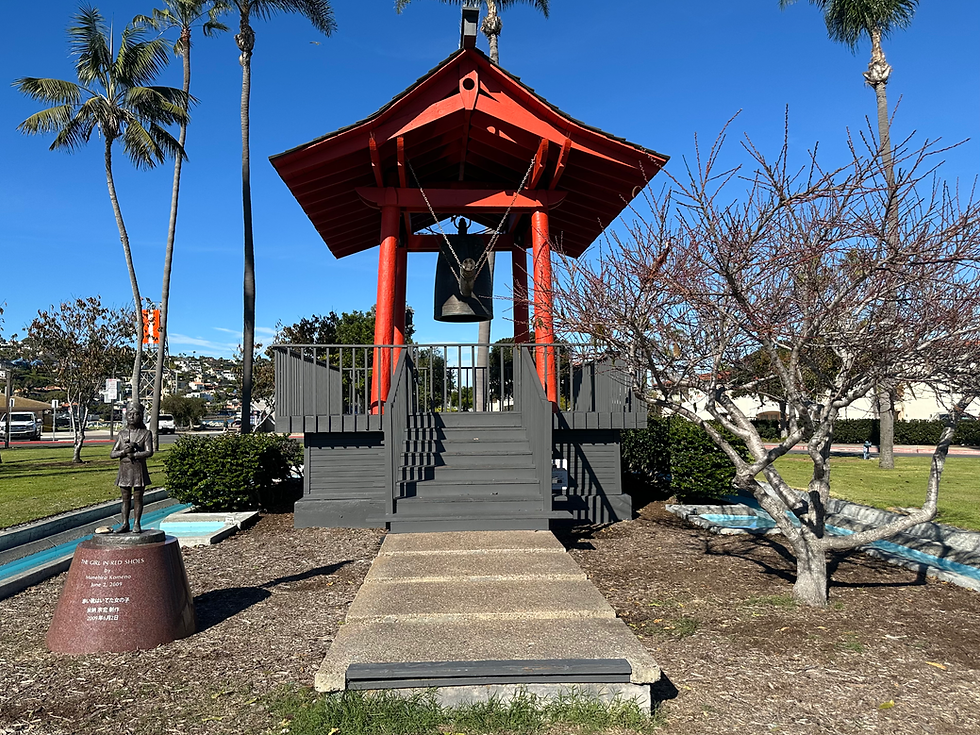
The monument to the Kanrin Maru landing was sculpted by Mitsui Nakai and Ishi Katsu. A gift from the Mayor of Osaka, it marks the centenary of diplomatic relations between the U.S. and Japan and was opened 17 May 1960. Astute followers of the PHG Blog will remember that the Japanese Friendship Bell in San Diego is two years older than this.
If you've been to see the Kanrin Maru Memorial, or visited Lincoln Park, please let us know in the comments! We're dedicated to connecting you to local and regional history, where you are.
Happy exploring,
Tony
Further reading:
Art and architecture: San Francisco
Historical Marker Database
Samurai Archives
History of the Kainrin Maru and wreck memorial
Cultural Heritage Agency of the Netherlands
National Diet Library - digital copy of a Japanese-language report on the 1860 embassy
Japanese-language website dedicated to the "new" Kanrin Maru, which operated in and around Awaji Island giving tours of the Naruto Strait and its whirlpools.


Comments