
Battleship Mutsu Memorial Museum

Greetings PHG fans! As you probably know, Suo-Oshima is one of my favorite places to visit in Yamaguchi Prefecture. Near the tail end of the island is a small museum dedicated to an Imperial Japanese Navy ship that most people have never heard of: the Mutsu. It was near here that the ship lay at anchor in the late morning of 8 June 1943, when she suddenly exploded and sank with the loss of 1,100 men.
The second and last Nagato-class battleship, Mutsu was laid down on 1 June 1918 at Yokosuka Naval Arsenal. Launched on 31 May 1920 and commissioned 18 months later, Mutsu was designed to be superior in every way to the British Royal Navy's Queen Elizabeth-class, and drove the U.S. Navy to build their own battleships in response. The arms race was cut short only by the Washington Naval Conference, which limited the amount and tonnage of capital ships allowed to the signatories of the various naval treaties treates decided there. The simplified table below shows the comparison between the three classes of ship. Note the range of the Colorado-class, a reflection of the distances these ships would have to negotiate in the event of a Pacific war.
Class | Built | Shaft Horsepower | Speed (knots) | Range (nm) | Main Armament | Secondary Armament |
Queen Elizabeth | 1912-1916 | 75,000 | 24 | 5,000 | 8x 15" | 16x 6" |
Nagato | 1917-1920 | 80,000 | 26.5 | 5,500 | 8x 16.1" | 20x 5.5" |
Colorado | 1917-1923 | 28,900 | 21 | 8,000 | 8x 16" | 14x 5" |
Mutsu was nearly lost to administration before seeing action; at the aforementioned Washington Naval Conference in 1921, Japan had to make the case to keep the ship in service. Fortunately, the ship was already commissioned and Japan argued she should be outside the terms of the Five-Power Treaty, which called for scrapping all capital ships currently being built in addition to limiting future construction. The IJN agreed to scrap the obsolete dreadnought Settsu instead. In David Evans' and Mark Peattie's "Kaigun", it is stated that Mutsu was built partly with public funds, some of which had been raised by schoolchildren, and this helped to convince the Japanese delegation to fight to keep her in service.
Mutsu's her first wartime action immediately followed her first reconstruction in 1936, in which her hull was lengthened, anti-torpedo bulges were installed, and she was outfitted with the means to support seaborne aviation such as catapults and a collapsible crane. Her top speed dropped to 25 knots post-reconstruction. Mutsu, along with Nagato supported Imperial Japanese Army action in China following the Marco Polo Bridge incident of 7 July 1937. They patrolled the coast, and supported Imperial Japanese Navy Special Naval Landing Force (SNLF) troops in Shanghai with their float planes.

Mutsu's battle history isn't as storied as some of the older Japanese battleships. The Kongo-class in particular were upgraded to keep up with fleet carriers, and literally left slower ships like Mutsu behind in their wake. As part of Battleship Division (BatDiv) 1, itself part of First Fleet, Mutsu sortied on 8 December 1941 to the Bonin Islands while the IJN's carrier force attacked the U.S. Pacific Fleet at Pearl Harbor. They returned to their anchorage at Hashirajima (Hiroshima Bay, between Etajima and Suo-Oshima) on the 13th, having taken no action. She did not fight at Midway either; BatDiv 1 followed roughly 300 miles behind Admiral Nagumo's striking force and did not engage the Americans at all.
In August 1942, she relocated to Truk along with Admiral Kondo's advanced forces in order to take part in the battle of the Eastern Solomons. The TROM has Mutsu taking little part in the action other than helping with gunnery exercises; she was slower than the Myoko and Takao-class heavy cruisers. In January 1943, she returned to Hashirajima. Although she was tagged for action in the Aleutian campaign, she did not leave Japanese home waters again.
On the morning of 8 June 1943, 113 cadets of the number 11 class A flight Reserve (Yokaren) 13th team and their instructors came aboard Mutsu for a familiarization tour. Moored nearby was the battleship Fuso, and Nagato was a few miles away, with the commander of the First Fleet aboard. At 1213, there was a blinding flash as the number 3 turret magazine exploded. Mutsu broke in two, with the forward section sinking quickly to the bottom. The stern section remained floating, upending in the sea.

An investigation started almost immediately after the explosion. Improperly stored ammunition, sabotage, and enemy action were all considered as possible culprits. The last of these are dismissed first. There's no reports of Allied submarines in the area, and no enemy aircraft in the area. The Allies hadn't taken credit for the sinking either, and from all appearances they didn't know it had occurred. There was a Sailor aboard the ship who had been accused of petty theft and was even scheduled to appear before a court the day of the explosion; while implicated in the explosion, the information was never corroborated. The Sailor's body was not recovered.

The matter of improperly stored ammunition was looked at thoroughly. Mutsu carried Type 3 "sanshikidan" shells, incidendiary anti-aircraft explosives that contained flammable components known for starting a fire when improperly stored. It was decided that the shells were not the primary culprit; survivors noticed a brown smoke coming from the number3 turret, and these shells gave off white smoke. The normal storage conditions allowed for the propellant to be kept safely underneath 80 degrees celsius, well below the temperature in the magazine. The investigation concluded that the explosion was "most likely caused by human interference." In the meantime, the IJN allowed the Type 3 shells back onto ships; they'd been removed during the course of the investigation.
It has never been confirmed how the magazine exploded, or if the Sailor in question had anything to do with it. The IJN went through great lengths to hide the loss of Mutsu. The survivors were transferred across the Pacific to remote locations like Tarawa, Truk, and Makin. Roughly 150 of them were killed on Saipan during the American invasion. Any mention of the ship and its fate were strictly controlled, the IJN used Mutsu's callsign at random times to confuse the enemy into thinking she was still at sea. I found this interesting tidbit in her TROM:
2 March 1944:
On that day, the USN Fleet Radio Unit, Melbourne, Australia (FRUMEL) issues the following comment:
"In regard to the continued absence of the battleship MUTSU from traffic, Honolulu now state they have some Jap prisoners of war who are definite that MUTSU was torpedoed in Home waters when on passage south and returned to Japan but her magazines blew up on arrival."
In 1948, the first rights to salvage the wreck were granted, but then got held up in the courts. A year later, a court authorized the salvage of human remains and personal belongings only. Finally, in 1970, salvage of the wreck began in earnest; it continued for 8 years. Much of the ship was scrapped, although one of her barrels is in Kure, another in Yokosuka, and several turrets and other parts proudly sit as museum pieces, notably the #4 turret, at the JMSDF academy in Etajima.


The Mutsu Memorial Museum on Suo-Oshima was opened in November 1972, and relocated to a new location in April 1994. Inside, relics from the ship and its crew are displayed proudly alongside some other artifacts from the Imperial Japanese Navy. Although there isn't much English-language material in the museum, with modern technology this is no big challenge. Outside the museum you can inspect parts of the ship overlooking the Inland Sea, next to an immaculate monument to those Sailors lost on the battleship. A memorial to the flight students lost on Mutsu, and during the Second World War in general, is nearby.
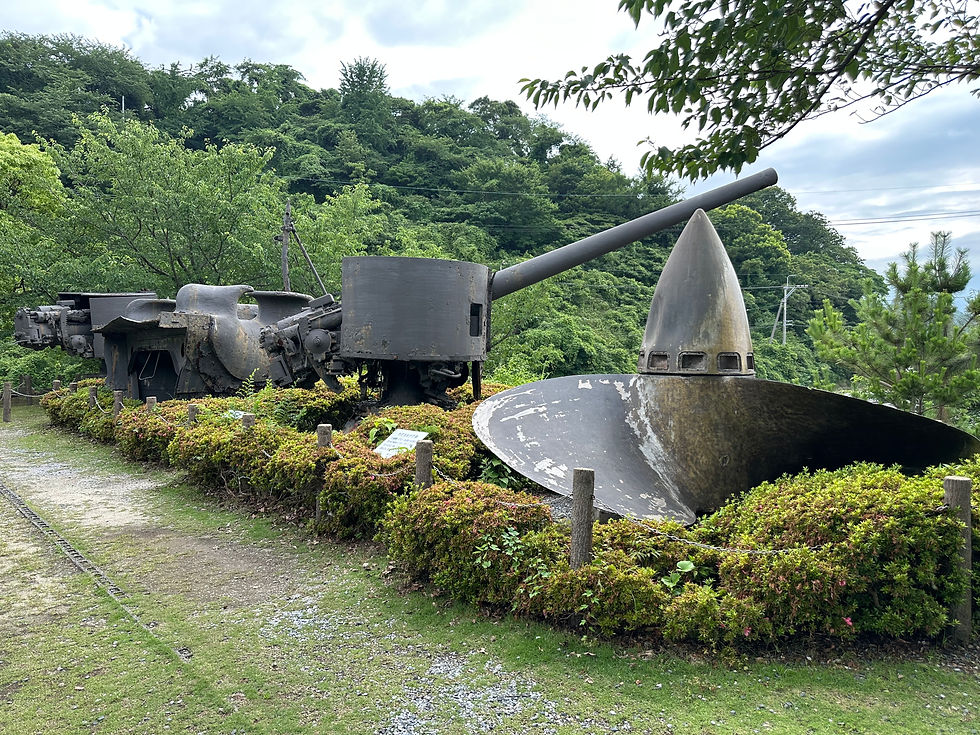


Battleship Mutsu, like her sister Nagato, deserved better ends; the ship had once held the attention of the world's most powerful navies, and the Sailors who died aboard her, or in the jungles of Saipan, were poorly served by the Imperial Japanese Navy leadership. They should never be forgotten, or ignored. Suo-Oshima is a 45-minute drive from Iwakuni CIty, and this is a great day trip for those of you stationed here who may be looking to avoid the Hiroshima traffic. The next time you're looking to explore, check out this fantastic island and this little known but important part of Imperial Japanese Navy history.
Happy discovering!
Tony


Comments